Optimizing Guide Rods of an Automotive Head Restraint
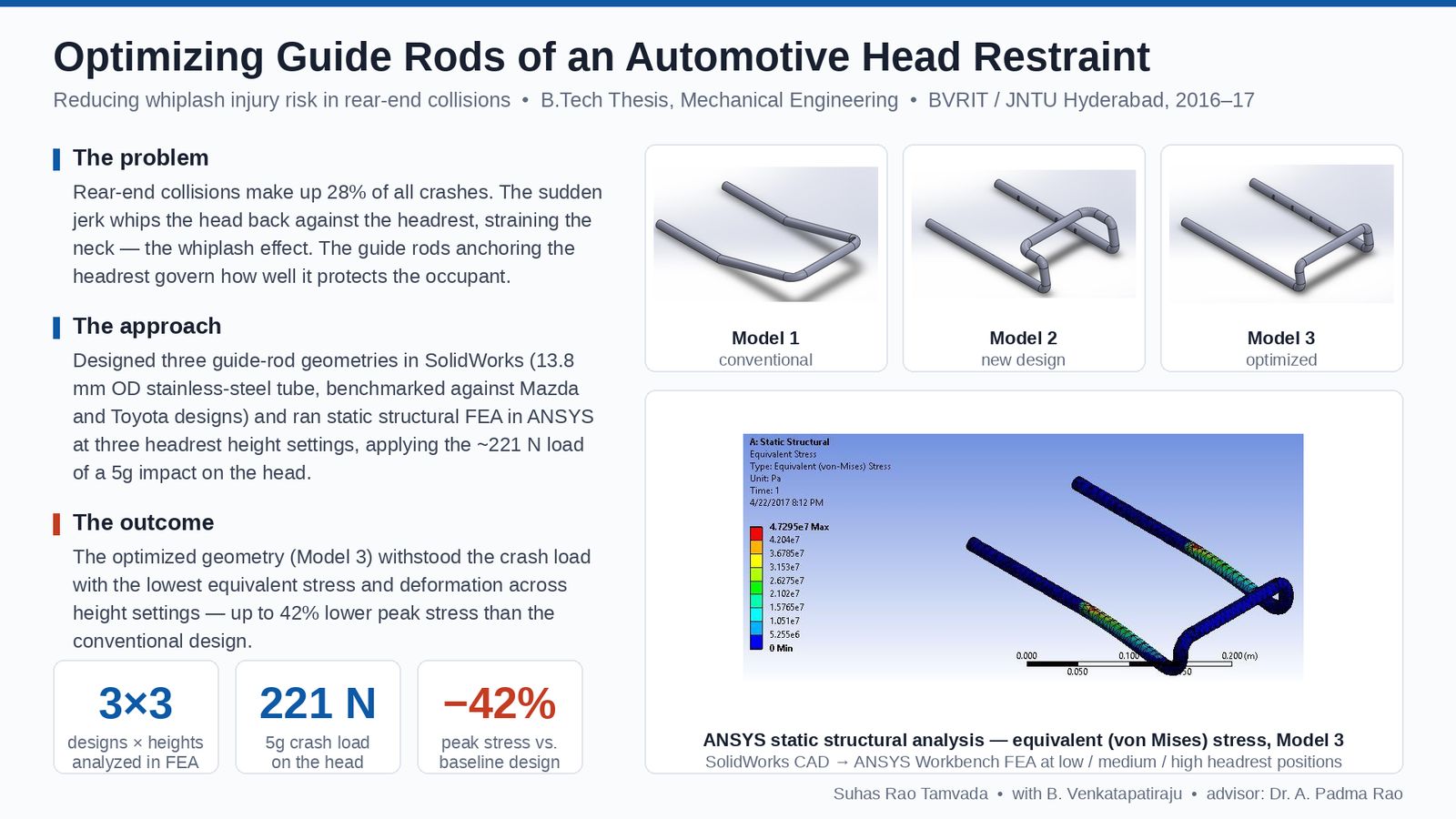
Rear-end collisions account for 28% of all automobile crashes, and the resulting whiplash injury is governed largely by how well the headrest — and the guide rods that anchor it — restrain the occupant's head. For my undergraduate thesis, I designed and optimized the guide rods of an automotive head restraint to reduce whiplash injury risk. I modeled three guide-rod geometries in SolidWorks (13.8 mm OD stainless-steel tube, benchmarked against Mazda and Toyota production designs) and evaluated each with static structural FEA in ANSYS Workbench at three headrest height settings, under the ~221 N load corresponding to a 5g head acceleration in a low-speed rear impact. The optimized geometry withstood the crash load with the lowest equivalent stress and deformation across height settings — up to 42% lower peak stress than the conventional baseline (47.3 MPa vs 82.0 MPa at the highest setting) — and was identified as the best candidate for a safer headrest.