Physics of Critical Heat Flux
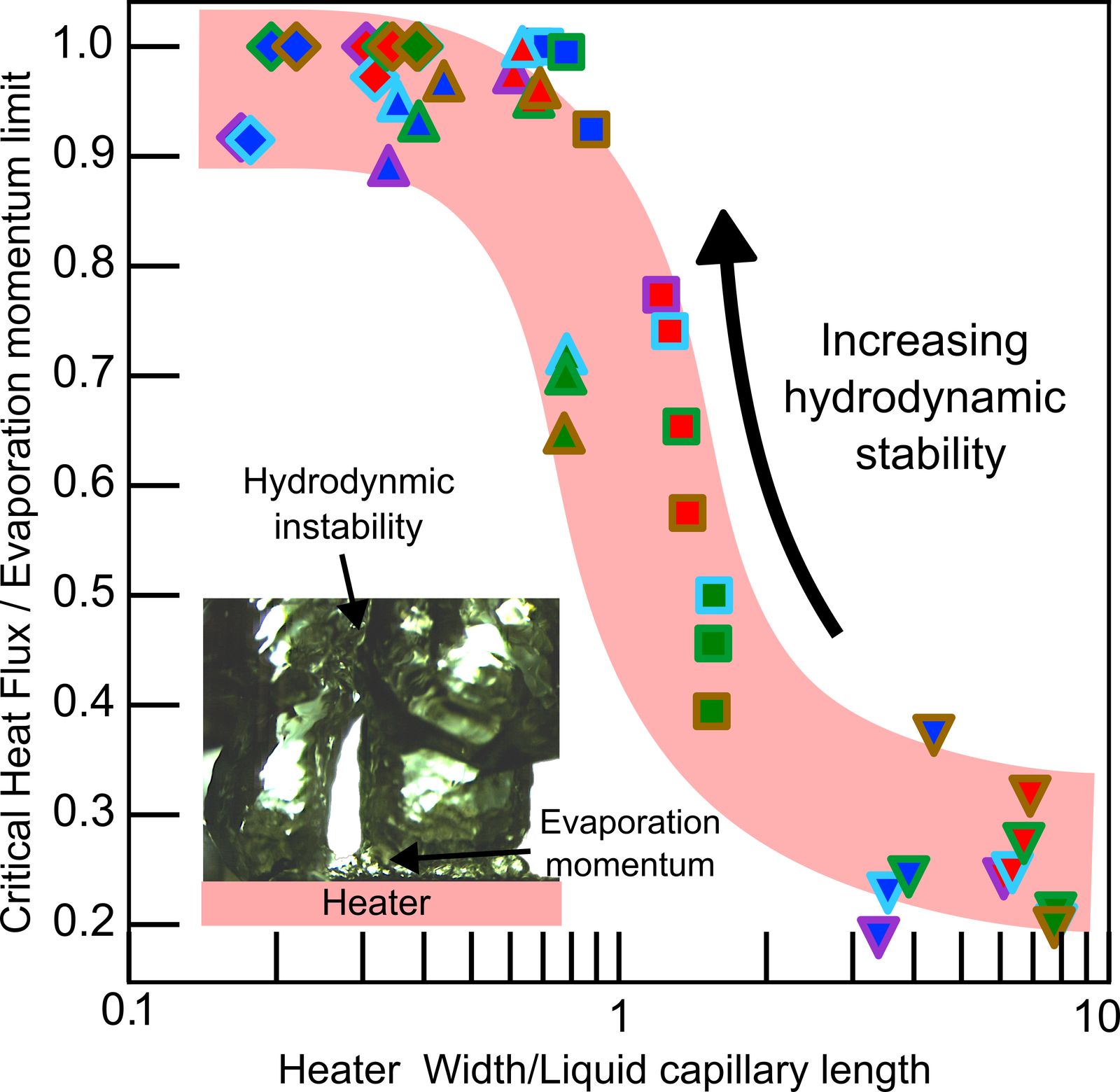
Critical heat flux — the point where a boiling surface suddenly and catastrophically fails to remove heat — has been an unsolved problem in thermal science for a century. It sets the safety limits of nuclear reactors and the power ceiling of electronics cooling. My PhD thesis resolved the forces acting on a departing bubble to show that the evaporation momentum limit is 3–4x higher than classical theory assumed, reconciling the two competing schools of thought (hydrodynamic instability vs. surface-based mechanisms). By stabilizing the flow near the surface we achieved a 6x increase in critical heat flux and a 5x improvement in heat transfer coefficient over the state of the art, and developed force-balance correlations that explain the physics rather than just fit it.